For a long time now, game modifications or ‘mods’ have occupied an important role in sustaining the replayability of videogames and the lifespan of their player communities.[1] As the field of historical game studies has flourished over recent years, it has also naturally begun to engage with the practice of modding, with useful terms like ‘digital-ludic revisionism’ being used to conceptualise the aims and practices of mods as they reframe and restructure game representations according to certain desires.[2] Within the specific context of historical games, it has been noted that these desires are also typically informed by a motivation to ‘correct perceived inaccuracies or insufficient nuance’ in how a game interprets particular cultures.[3] For strategy games like the historical titles in the popular Total War series, which combine turn-based gameplay with real-time tactical battle simulations, these pursuits remain an important yet understudied facet of their modding cultures. In these games, the player chooses a historical culture or nation to play as through a specific period of history, depending on the game setting. Their goal is to achieve victory primarily through territorial expansion and conquering their rivals’ lands.[4] This is supported by exploiting resources, growing the economy, constructing buildings and armies and researching new technologies.
In this post, I will explore two modifications for Total War: ROME II (2013, Creative Assembly), namely the overhaul mod Divide et Impera (2014) and the re-skin mod Legendary Empires HD (2022). This study prompts many questions about the uses of modding to explore representations of the past, though I will focus on two specific questions. Firstly, what insights do they provide into the appearance and equipment of ancient Carthaginian armies? Secondly, through being situated in a game that represents the past and engenders counterfactual thinking, what can they tell us about how Carthage’s military might have evolved further if it was victorious in the Punic Wars?
In the academic world, it is only relatively recently that the study of ancient Carthage (as part of the more widely termed ‘Punic studies’), has become a centre for research activity in its own right. Part of the motivation for this has been to distance new research on the Punic world from outdated populist and orientalist interpretations which have deliberately sought to ‘other’ its peoples as embodying the worst forms of cruelty, duplicity, avariciousness, sexual promiscuity and ‘sinister exoticism’.[5] Not only are there semblances of this form of othering in classical sources (written chiefly, but not solely, by Carthage’s rival and conqueror, Rome), but it is also a product of modern European colonialism.[6] Militarily speaking, this presents its own problems for how we might view the historical development of Carthage’s military, which is also susceptible to being categorised as a rather uncivilised grouping of disparate communities and ethnicities (‘barbarians’, if you like) whose only worthwhile successes were achieved under the leadership of Hannibal Barca.[7] It is important, I would argue, to view the development of digital strategy games and the access they offer for seeing, understanding, and playing as previously ‘othered’ cultures as a significant contributor to distancing ourselves from such negative connotations.
The historical context relating to how Carthage has been treated is partly why it makes it so interesting from the perspective of historical games studies and player engagement, and which is also why I’ve chosen to feature it here. For a civilisation which occupies such a critical role in Roman historiography and in the making of European history, its relative obscurity in popular history finally has the potential to be remedied on the screen as much as it does beneath the ground through archaeological excavation and innovation.[8] Anecdotally, it’s possible to speak to Carthage’s obscurity in the present day even from talking about writing this post with interested colleagues, family members and friends, who invitingly responded to me with the question ‘What’s Carthage?’
The post is structured into four sections. The first section briefly touches on a selection of literature that specifically addresses Carthage’s conduct and appearance in war. This is followed by a discussion of the advantages that videogames provide for modern audiences and how modders engage with these through concepts like ‘configurative resonance’. The third section touches on the importance of the problematic terms ‘accuracy’, ‘realism’ and ‘authenticity’. Finally, I move on to a case study of the mods Divide et Impera and Legendary Empires HD in the videogame Total War: ROME II.
The ‘Face’ of Carthaginian Warfare
There are, of course, written studies on the history and evolution of Carthage’s military and its approach to warfare.[9] We also have illustrated visual guides which, while aiding our own interpretation as interested individuals, often serve as important reference points for mod developers specifically working on the representation of military units in historical videogames.[10] In the context of the wars between Carthage and Rome, studies like these can also be seen more broadly as part of a scholarly tradition to help articulate and answer questions about, using various methodologies, the ‘face’ of Punic War battle(s) to gain better understandings of how armies fought in these periods.[11]
Modern media, including films, television and – critically – videogames, can (and should) serve as critical contributors to people’s understanding of military history alongside our collective appreciation of ancient history. It has also become increasingly apparent that digital games can suggest and help to explore many enticing research questions, ranging from issues spanning multiple historical periods to those that are more focused on particular cultures. For example, how was a soldier’s psychology affected by the physical environment around them? What sequence of events would need to occur in order to entail a mass route of an army? How would certain troop types in the Punic Wars actually engage one another? Crucially, what did the composite elements of Carthaginian armies look like?[12] The representations afforded by historical videogames and, I believe, the unparalleled possibilities of modding must be at the forefront of our minds when responding to these questions.
The Potentials of Videogames and ‘Configurative Resonance’
Like many of us of a certain generation, I grew up with videogames, and this played a significant role in fostering my passion for history from an early age (alongside some encouragement from parents). To this day, I’m not quite sure whether amassing over 1,000 hours each in both Total War: ROME II and Total War: NAPOLEON (2010, Creative Assembly) should be regarded as achievements or not. On many other occasions, I will have played a game about a historical setting before then proceeding to read something about it. Indeed, ‘for every person who reads [or, indeed, writes] a book on a historical topic … many millions of people are likely to encounter that same past on the screen’.[13] This is an incredibly important statement. Consequently, my very first exposure to the history of the Punic Wars was by playing through the historical battles of the River Trebia and Lake Trasimene in Rome: Total War (2004, Creative Assembly), alongside watching the excellent 2006 BBC docudrama Hannibal: Rome’s Worst Nightmare starring Alexander Siddig.[14] Only after that did I start consulting books on the topic. This has all constituted a personal journey where my curiosity has been nurtured by the information presented in games and in film, where I am then subsequently inspired to undertake historical research as a result. [15]
Crucially, this is not a linear journey, as my engagement with literature is then followed by a return to the games with that additional level of understanding, creating a kind of contextual loop.[16] In a videogame simulation of a battle, the player’s capacity for seeing, re-enacting, and crucially controlling it and its composite elements all constitute ‘dynamic interactive models of what was essentially a dynamic and interactive affair’ and, as such, can ‘advance our understanding (if not our knowledge)’ of ancient warfare.[17] To use a phrase by Adam Chapman, as well as being able to read history (including by forming our own interpretations of what we read in games as well as texts), we can also do it in a videogame before reading about it again outside the game space.[18]
In his 2010 work on gaming ‘rhythms’ as explored through the material experiences of players themselves, Apperley introduced the concepts and types of player resonances and configurative resonance as useful aids to the terminology used for analysing games.[19] In his interpretation, resonance ‘describes the outcomes of players’ configurations that have a particular bearing on a local situation, or context’ (with the local context amounting to simply the location of play as well as relating to wider social or cultural factors).[20] Chapman expanded on this notion by drawing on historical resonance as ‘the establishment of a link between a game’s historical representation and the larger historical discourse, as the player understands it’.[21] It is important to recognise the particular importance of configurative resonance because it helps to frame approaches and motivations to answering the questions relevant to this post. In essence, configurative resonance relates to how we, as players, deliberately play in a certain way or configure a game to how we want it to be according to our own individual preferences, and it is a very relevant concept for the act of modding. This might be a preference or experience that resonates ‘narratively, emotionally, ludologically, or more’.[22] As an individual who developed a very early interest in the history of Carthage through videogames and other media, for example, I might be concerned with achieving either a more accurate or sufficiently authentic (more on that shortly) depiction of its armies in Total War: ROME II because I am dissatisfied with what the un-modded or ‘vanilla’ game offers. Part of this dissatisfaction, though, also stems directly from my subsequent engagement with literary material after playing the game, such as an illustrated visual guidebook, and feeling the desire to achieve a similar level of nuance by configuring unit appearances in the game through mods. Compared with what mod developers have sought to achieve, the ‘vanilla’ game, for example, will typically not contain the same level of detailed variation between the types of equipment used across different cultures and within individual units in the same culture.
Even though making changes to unit appearances may have no ludic advantages whatsoever, a practice that Chapman has pointed to, it is important because it creates a specific resonance for me leading to greater personal satisfaction and enjoyment in gameplay.[23] This is one example of configurative resonance. Perhaps more importantly, it helps me to achieve an extra-telic goal of being able to possess a more well-informed understanding of the (possible) equipment and tactics of Punic forces, with the added unique benefit of seeing them in motion on-screen.[24] Despite a shortage of substantive empirical data that might help us to understand these kinds of behaviours among groups of players using mods, the evident popularity of community-made content suggests that the associated tendencies towards configurative resonance are not uncommon. Divide et Impera, for example, boasts a minimum of 400,000 ‘subscribers’ on the digital distribution platform Steam, but the true number of users is likely to be much higher owing to downloads made separately on its website.[25] It was also named the Creative Assembly’s ‘Best Overhaul Mod 2014’, ‘Most Innovative’ for 2015 and also won two Player’s Choice awards in the same period.
Accuracy / Realism and Authenticity
Arguments concerning accuracy and authenticity in historical videogames are well-trodden. In some ways, this also extends to how game modifications seek to frame themselves and define what their goals are. The description for Divide et Impera on its Steam homepage states that it ‘seeks to provide a challenging, historically authentic, realistic experience of the ancient world and warfare’.[26] This is somewhat akin to the aims of previous overhaul mods set in classical antiquity, for example the much-discussed Rome: Total Realism modification for the original Rome: Total War.[27] Divide et Impera’s ultimate goal is to make each faction feel truly unique for the player to experience with distinct cultural traits and specialised mechanics. One way it achieves greater realism, separated from authenticity, is by simulating combat which more closely fits how many ancient armies actually fought compared to the base game (for example, the importance of maintaining cohesive formations or exacerbating the causal effects of mass routs of armies using envelopment tactics).
Conversely, the effort to make literally each faction unique is not necessarily driven by the need to be as realistic as possible, but to create authentic environments for the player that both feel ‘sufficiently real’ and faithful to the historical context in which they are set, balanced against the need to be attractive from a gameplay perspective.[28] In ancient Gaul, we may know that there probably wasn’t much of a distinction to be made between the appearance of warriors from the neighbouring Arverni and Aedui tribes, but in Divide et Impera, a conscious effort is made to separate the two – if not in appearance, certainly in descriptive detail (for example, Arverni Spearmenas opposed to Aedui Spearmen). The benefits for the player are such that playing or encountering each faction feels like a truly unique experience in their game’s narrative. In this regard, the representation of cultures feels more closely like a ‘conceptual simulation’ (communicating with us about the past ‘without purporting to show it as it appeared’) rather than a ‘realist’ interpretation (where the aim is to show the past ‘how it was’ and how it actually appeared to historical contemporaries).[29]
In the case of Carthage, Legendary Empires HD seeks to provide even greater visual detail for the components of its armies that builds on the close attention paid in Divide et Impera to, for example, the array of ancient cultural motifs that feature on soldiers’ shield designs.[30] Combined with elements of an inevitable artistic freedom on the part of the author (which is hardly unique, as it is also a feature of many textual illustrations), the mod also references the use of original oriental models in its credits alongside using assets from other mods that are rooted in real historical findings.[31] This is perhaps one working example of the ways in which accuracy, or ‘realism’, and authenticity are in ‘any given game’s representation of history … balanced against each other’.[32]
Case Study: Divide et Impera and Legendary Empires HD
I will now move on to demonstrate some of the visual details made possible in Total War: ROME II using my specific setup of the game, which includes Divide et Impera and Legendary Empires HD as the main mods for determining unit appearances. Within the constraints of this post, I have chosen to focus on a small selection of units that are perhaps most emblematic of Carthage’s military both before and during the Punic Wars. The captioned names of the units are the names that appear in-game, and all images were captured by the author.
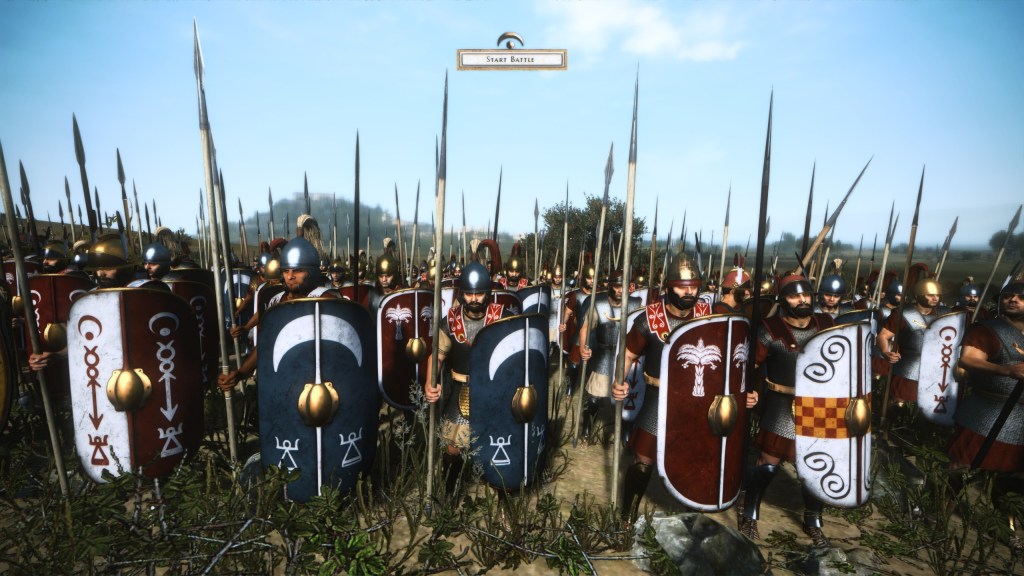
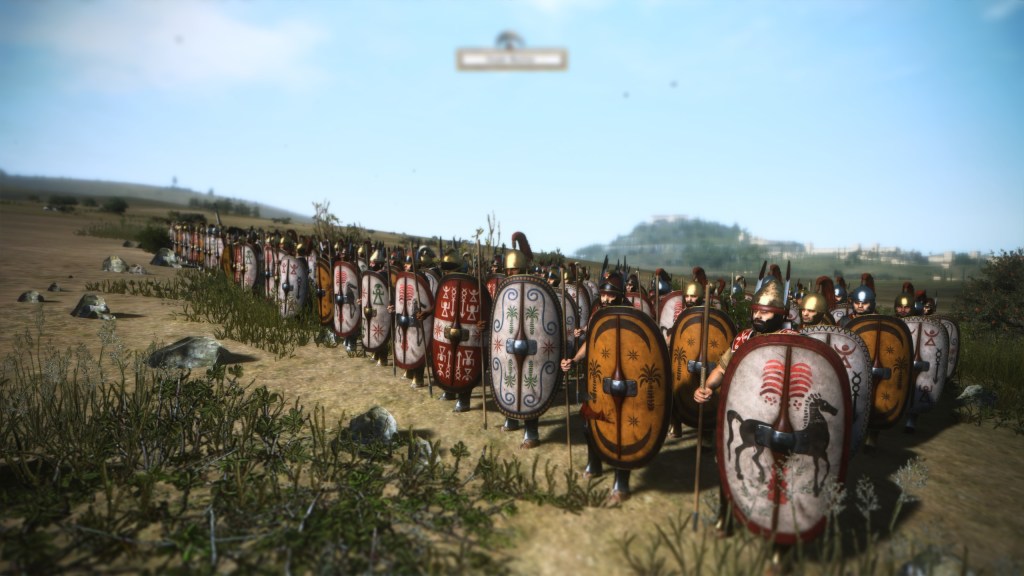
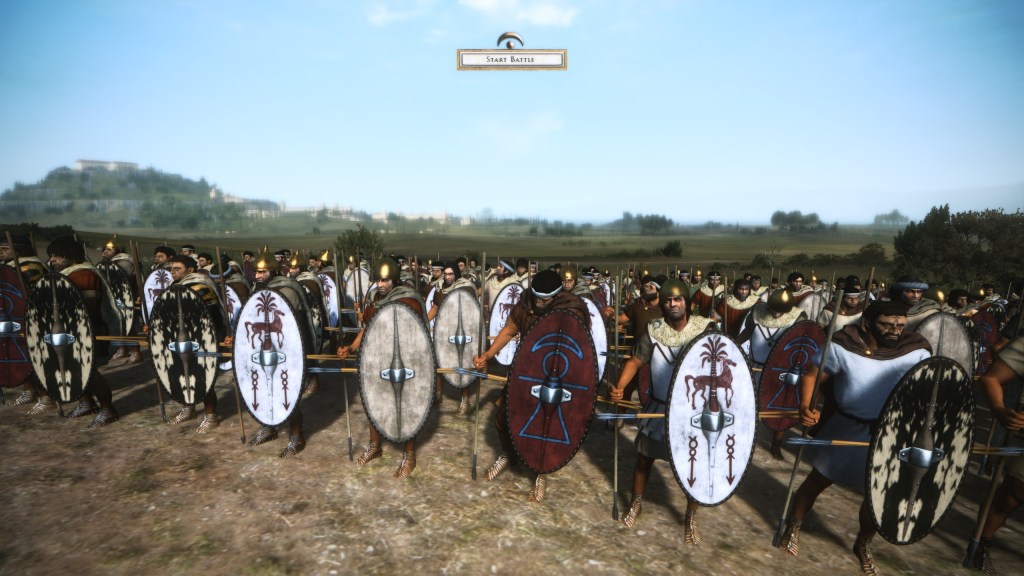
In figures 1–2 below, we see images of Liby-Phoenicians (an ethnic group made up of Punic settlers and native Libyans, who often intermarried) representing a similar cultural mashup in the types of equipment being used for war. These appearances are all made possible by the combination of the mods in question. These ‘late’ units are also only accessible by the player through military ‘reforms’ which occur after time progresses past a certain point (i.e., the player hits a specified number of turns) and are intended to portray elements of Hannibal Barca’s army during his campaign in Italy during the Second Punic War (218–202BC). The Greek historian Polybius wrote that, after Hannibal’s decisive victory at the battle of Lake Trasimene in June 217 BC, Carthaginian troops started to use captured Roman equipment as part of their armament and as an adaptation to their technology and battle tactics.[33] The most visible of these is the Scutum shield, plumed helmets and mail body armour. These developments are also conveyed in the historical information that the game provides when the player hovers their mouse over a particular unit. For the Liby-Phoenician swordsmen, we are told that ‘Equipped with mail armour, specialised scutum shields, and well-sharpened swords, these men take advantage of the latest concepts in tactics and warfare.’
In these examples, the original shield designs have been replaced with several painted motifs emblematic of Carthage – notably the crescent moon shape, the Sign of Tanit (named after the Punic goddess) and also the horse and palm tree, which also featured on many Carthaginian coins. In this example, Legendary Empires HD takes a military unit from Divide et Impera as its blueprint, and expands on it further by adding the greater and graphically enhanced variations in shield designs and the high-definition quality of the soldiers’ armament, especially their mail armour. As a result, the portrayal here is altogether far more intricate.
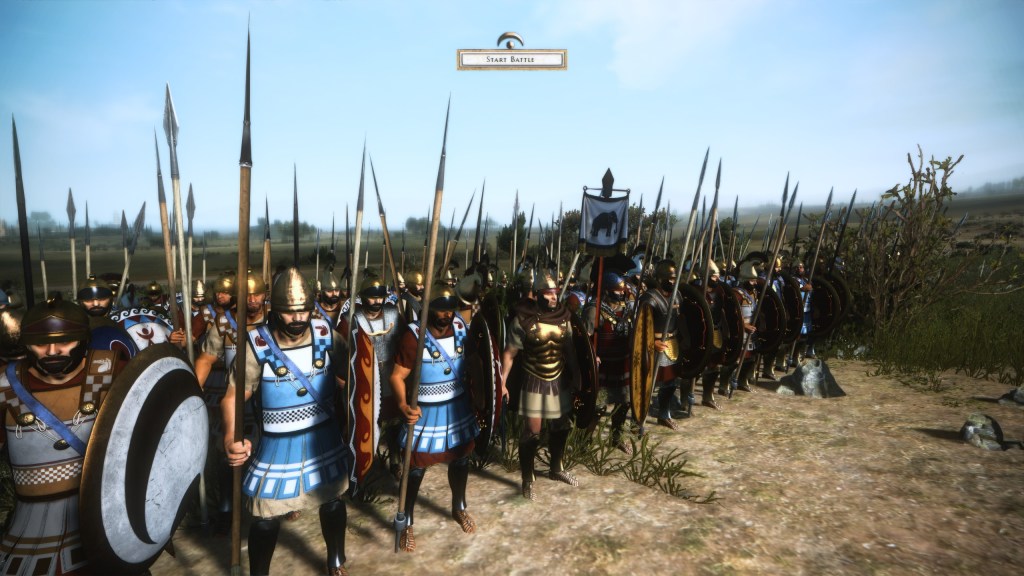
In figure 3, we similarly see Liby-Phoenicians, but representing an earlier style of warfare. These troops would have fought much in the same manner as Greek hoplites, using the Hoplon shield and a thrusting spear to present an impenetrable wall of bristling spear points known as the Phalanx. Liby-Phoenicians likely accompanied Hannibal to Italy, and prior to their various encounters with the Romans there, a more common feature of their body armour is the Linothorax, or linen breastplate. The historical information pertaining to these troops reads ‘Defending one’s home is not exclusive to the nobles and pureblood Phoenician citizens of Carthage. These men have also learned how to use the phalanx and the shield to their best advantage.’
Again, Legendary Empires HD performs a similar feat; expanding on the historical variation of shield patterns and the Linothorax itself. The aim here, as is the case in many other examples, is also to convey the reality that armies in this period did not operate with professionally standardised equipment and uniforms like modern armies do. Like many other combatants in the Classical and Hellenistic periods, Carthaginians and Liby-Phoenicians were responsible for purchasing their own equipment, meaning that it was rare for any one individual to look exactly the same as the person standing next to them.
Figures 4–7 represent another defining feature of Carthage’s military – its reliance on Celtic and Iberian mercenaries. As the centuries progressed, the native citizen troops of Carthage became more and more confined to the homeland and, unlike its subject populations, they were not compelled to serve in the city-state’s armies. Along with the Liby-Phoenicians, mercenaries progressively made up a larger and larger contingent of many of Carthage’s armies operating abroad. The infantry and cavalry commonly wielded a mixture of spears, iron longswords, and ornate round or oval shields. For protection, they wore mostly iron or bronze helmets along with leather armour, bronze breastplates and occasionally mail or scale body armour for the heavier troops. As shown in figure 6, the Iberian foot soldier can be seen wielding a steel sword called a falcata, which was used to great effect against the Romans. Finally, we can see the lightly-armoured Balearic slingers, which affords them the ability to manoeuvre quickly around the battlefield and pepper their foes with missiles from afar.
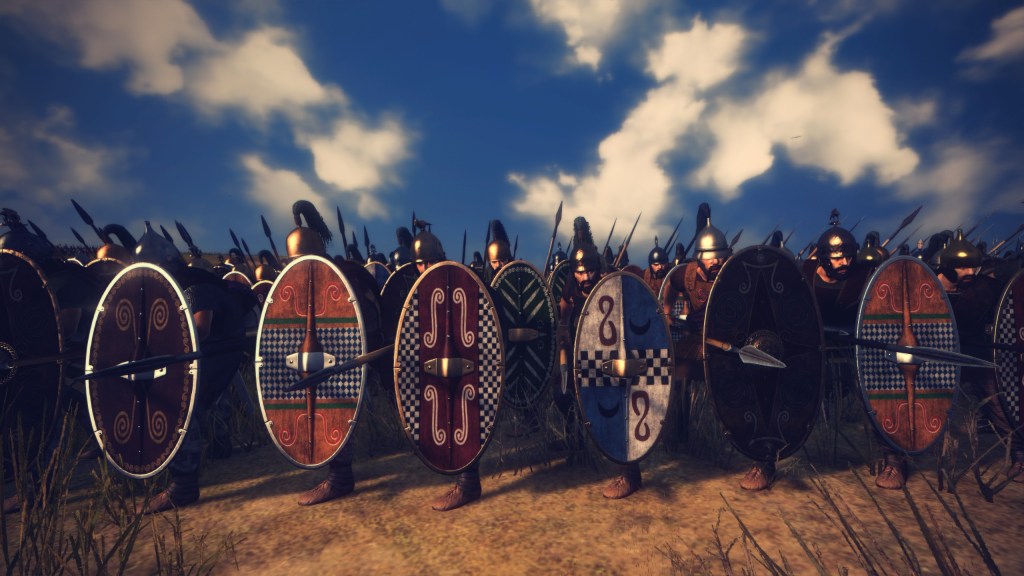


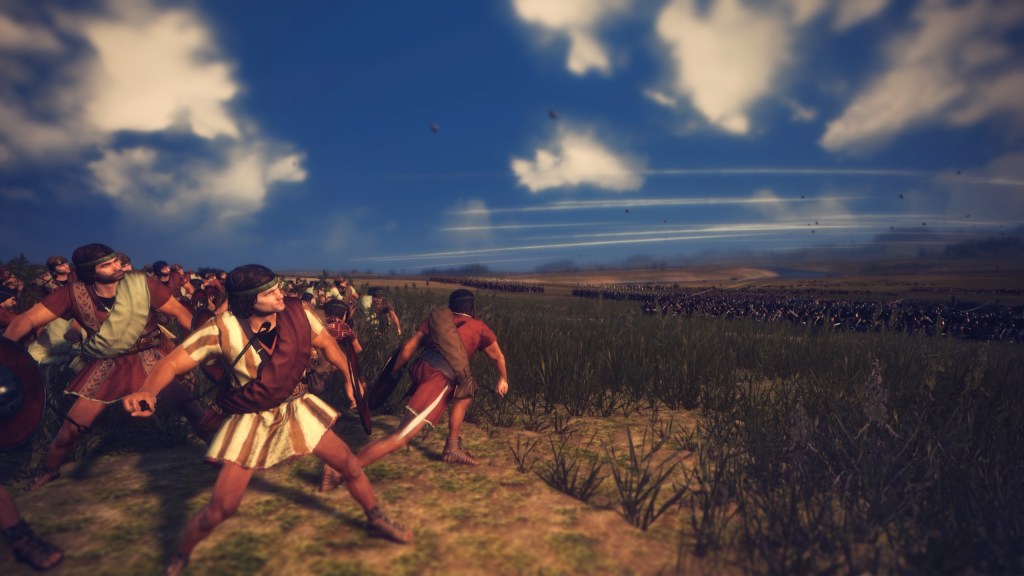
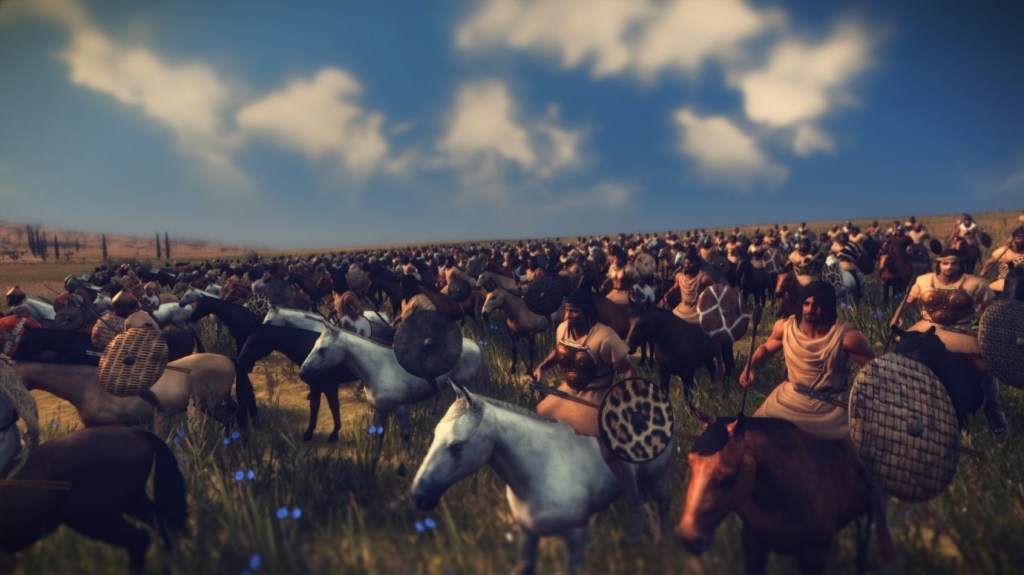
Figure 8 shows arguably one of the most famous contingents of Carthaginian armies, especially that under Hannibal Barca – the Numidian cavalry. The warriors of the north African region of Numidia are referenced many times in the ancient sources, with their saddleless horses and agility in warfare being second to none. Their javelins and small wicker or hide shields supported their role in skirmishing and harassing their opponents.
The subject Libyan populations of Carthage also comprised large numbers of light melee infantry armed with javelins, a curved Kopis sword and a large oval shield called a Thureos, which is visible in figure 9. The Thureos is an interesting inclusion because it represents the changing nature of ancient Mediterranean warfare, in particular as Hellenic cultures (including cultures that fought like them, such as Carthage) increasingly adapted their equipment and tactics due to encounters with Rome. Similarly to the ‘late’ Liby-Phoenicians that are modelled on Roman methods of warfare, the Thureos only becomes available once the player hits a set of military reforms which provide their armies with new equipment. The Thureos could be used as part of a formation of infantry whose purpose was to hold a formation, or as part of a mobile flanking force with the use of debilitating javelins.
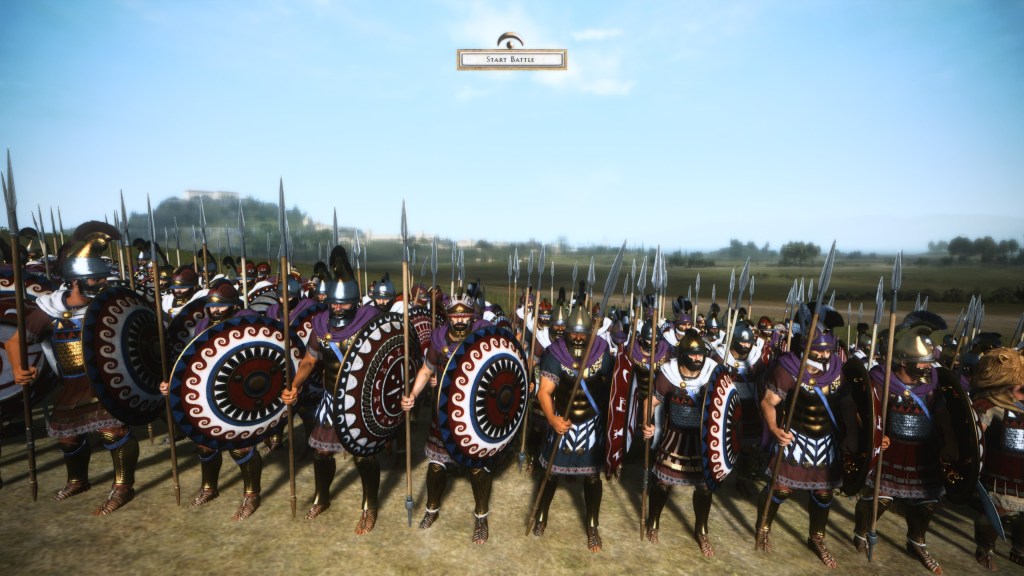
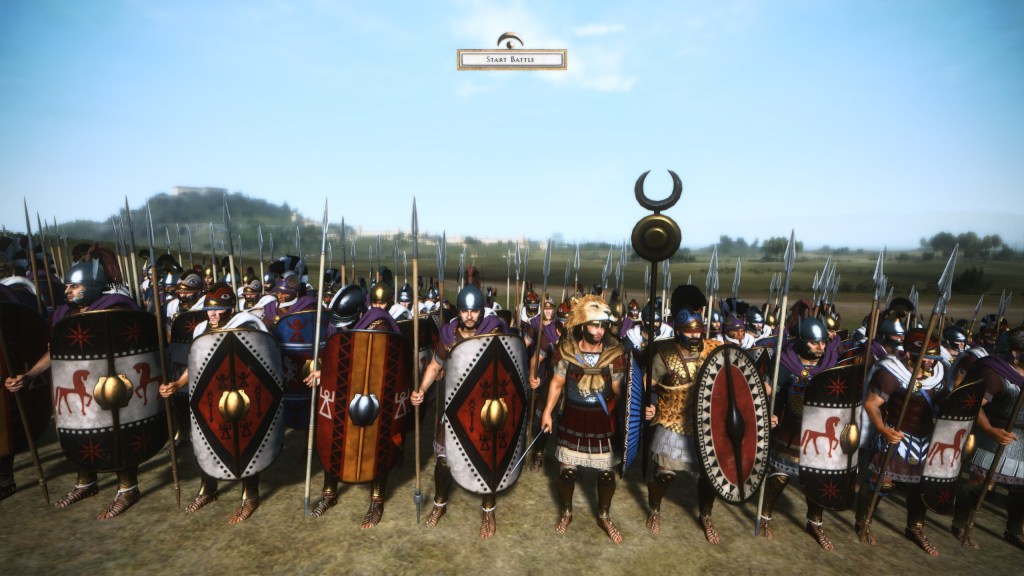
In figures 10–11, we see one of Carthage’s most renowned and elite formations of veteran hoplites, known as the Sacred Band. The Sacred Band were only raised in Carthage itself and consisted entirely of wealthy citizens who could afford all their own equipment. Alongside their resplendent shields, scale armour and muscle cuirasses, Legendary Empires HD chooses to depict them in purple cloaks, a reference to the regal connotations of the colour amongst ancient Phoenician royalty and the production of purple dye which many Phoenician settlements in the Levant were known for. We see limited references to them in the ancient sources, partly owing to the fact that their numbers were either incredibly limited or, more likely, completely non-existent by the time of the Punic Wars. The last time we see a direct reference to them is their defeat at the Battle of the Crimissus against Syracuse in c. 340 BC.
In Divide et Impera, the Sacred Band are separated into two iterations; an ‘early’ and a ‘late’ version. Similarly to figures 1 and 2, the late version is intended to reflect the changing style of warfare through new military encounters and ‘reforms’ which see the adoption of the Roman Scutum shield. Yet, owing to our reasonable assumption that the Sacred Band were long gone by the time Hannibal Barca was campaigning, their existence is completely hypothetical. While their inclusion might primarily be aimed at maintaining gameplay balance between cultures as the player advances through time and new global military technologies are unlocked, they also represent an intriguing source of conjecture for the possible development of Carthage’s military if it was victorious in the Punic Wars, achieved sustained mastery over the western mediterranean, and then became less apprehensive about using more of its own citizens for military service once again. Therefore, their presence in the game adds yet another layer to the myriad ways in which the player may engage with counterfactuals that, crucially, is not present in the vanilla game. By simply existing as a design choice, the late iteration of the Sacred Band is making a counterfactual point in and of itself before becoming a product of a player’s configurative resonance through choosing to use them in the mod. It also establishes historical resonance by speaking directly to tantalising ‘what if’ questions surrounding Carthage’s, and specifically Hannibal Barca’s, eventual fortunes.
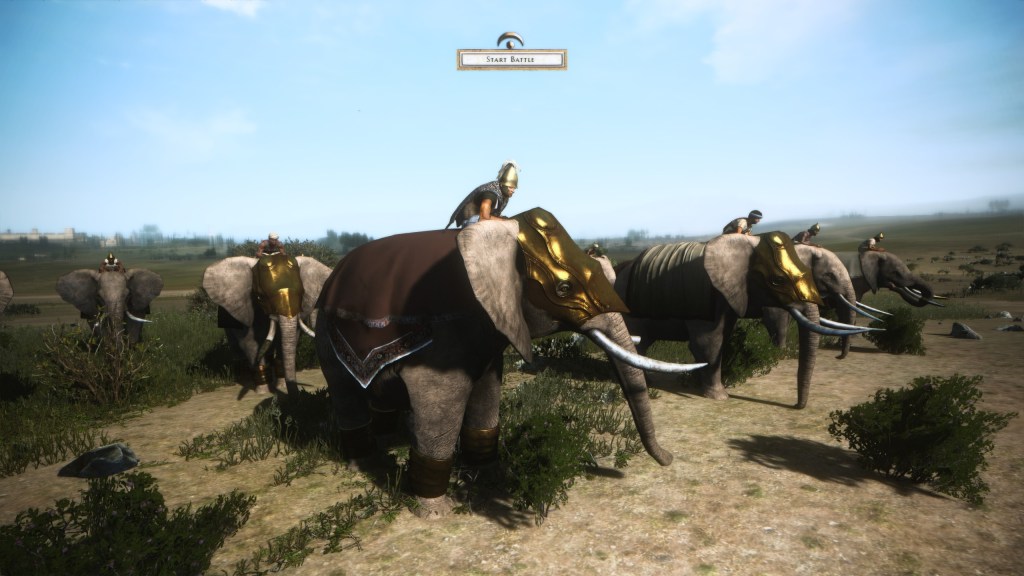
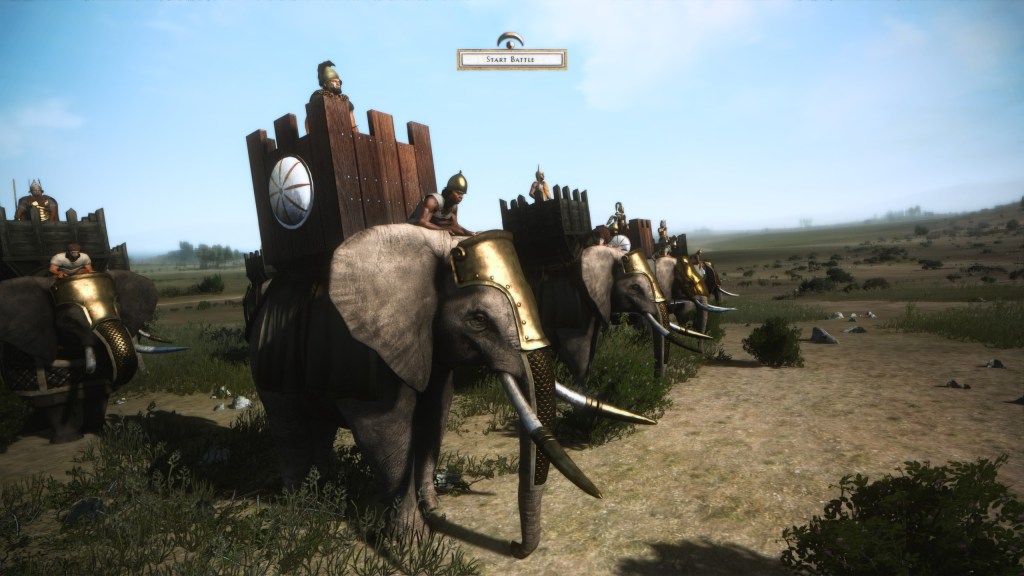
Finally, it would be surprising for any discussion of Carthage’s armies to not mention war elephants (figures 12–13). In popular history, war elephants remain synonymous with Hannibal Barca, perhaps more so than any other ancient military leader, as the various depictions of his legendary crossing of the Alps demonstrate. Not surprisingly, these have made their way into representations in games.
Again, in Divide et Impera, there are different types of elephant units that can be fielded and which offer a nuanced understanding of their evolution in warfare, in particular, the different species and sub-species that existed in antiquity. The use of elephants in warfare is generally believed to have spread westwards after Alexander the Great encountered them while on campaign in India, and the last elephant in Hannibal’s army in Italy (Surus) may have been a larger Syrian variant. The most common species of elephant fielded in Carthaginian armies was the (now extinct) North African Forest Elephant. In addition to these, Divide et Impera also chooses to distinguish elephants hailing from the Atlas mountain range (across modern day Morocco, Algeria and Tunisia) as forming an ‘elite’ of the elephant core in Carthage’s forces. This variant is equipped with heavy armour and a wooden tower known as a Howdah which can carry prominent figures atop it or allow soldiers to rain missiles down below during an elephant’s terrifying charge.
The examples shown above can represent valuable visual aids for a more nuanced understanding of the appearances of ancient Carthaginian armies. Through the potential of this and other modded configurations, we are able to experience up-close the extraordinary attention to detail that is paid by mod developers to improving a sense of realism in one aspect, and a sense of authenticity on another. The former is achieved by an active effort to represent more closely the actual historical trajectory of ancient warfare, made possible in ludic form by the presence of military reforms that are absent from the vanilla, non-modded game. The latter is achieved through the existence of units that we know are anachronistic but which feel ‘real’ in the context of a game which nurtures the production of counterfactual narratives. In this context, we see a heightened sense of authenticity towards an imagined alternative history. By incorporating military reforms and splitting specific units into ‘early’ and ‘late’ iterations, Divide et Impera expands the parameters of both technological evolution and counterfactual thinking within the game further. This becomes necessary both for improving popular understandings of how ancient military equipment and tactics actually evolved (for example the later adoption of the Thureos), and for offering reasonable conjecture for how they may have evolved further if history turned out differently.
In the context of Carthage, this is part of what makes the period of the Punic Wars so historiographically interesting.[34] In the modded configuration, what becomes clear in how Carthage’s military is represented is the emphasis on the gradual adoption of Roman equipment for its heavier troops. Not only is this rooted in the historiographical example of Polybius (regardless of its veracity), it also establishes historical resonance by becoming relevant to wider historical discourse surrounding the inevitability of conflict between Rome and Carthage for mastery of the western mediterranean. Because their fates are often presented as being so intertwined, stretching all the way back to the mythological roots of Dido and Aeneas’ love affair, their intrinsic reliance on each other as determinants of each other’s fortunes is given extra weight in ludic form. In other words, the only meaningful way that Carthage’s military is seen to evolve is through military encounters with Rome and, subsequently, ultimate victory over her in a bloody war.
Conclusion
In the digital age that we are now living in, it has become more and more important to reflect on the affordances of historical games as modes of popular history owing to their prevalence and as subsequent contributors to our understandings of the past.[35] Consequently, it also feels worthwhile to reflect more closely on the role that mods play in this as configured representations of the games themselves and as evidence of engagement with wider historical discourse by their player communities.[36] It is easy to track both their development over time and the inspiration that developers draw on in their design processes, partly owing to how transparent they are in publishing changes made (known as ‘change logs’) and how readily they engage in discussions with their fan bases about the decisions they make and the literary and archaeological sources they use.[37] Critically, being mostly volunteers and choosing to release their products for free, there is also often little to no commercial incentive for mod developers, reflecting the likelihood that their interests are driven more strongly by their inherent passion for the period they are working on.
At the same time, however, modders must balance any desire to alter game systems with the need to maintain playability, and this is not achieved simply through having more visually pleasing visuals. The way in which Divide et Impera develops on the base game causes it to have even greater replayability, as the presence of the reforms system and the gradual ‘unlocking’ of specific units encourages a more sustained investment in the game on the part of the player. In an ingenious way, it does this while simultaneously providing us with a more well-rounded understanding of the evolution of ancient warfare.
There is, however, something to be said about the graphical quality of Total War: ROME II, further improved upon by its mods, compared with that of older historical Total War titles. ROME II is simply a newer game with better graphics owing to more advanced technological capabilities, and mods have come quite a long way since the original forays into Rome: Total Realism. This means that modders, too, are able to reconstruct aspects of the ancient world with even greater levels of detail as the digital human entities that constitute armies all appear, move, and sound more lifelike with each iteration in the series.
Finally, many of the explorations discussed here become more potent when considered in relation to cultures and civilizations that have struggled to attract attention to the extent that Greece and Rome have. This is because games have become increasingly accessible and engaging alongside other media. In other words, it is even more likely that individuals, with myself as a case-in-point, are going to encounter Carthage for the first time on a screen, and it can only be beneficial for our analytical focus to be balanced accordingly.[38]
Edward Hammond (@baalhammond.bsky.social) is in the first year of his PhD studying Classics and Ancient History at the University of Bristol and is a member of the Bristol Digital Game Lab. He is interested in the ways in which historical strategy games set in antiquity contribute to present-day receptions of ancient Carthage and Punic civilisation more widely. His PhD thesis, provisionally titled ‘In the Shadow of Rome: Memory and Modern Receptions of Ancient Carthage through Experimentation in Total War, Civilization and Old World’, sits at the cross-section of analyses of ancient historiography, cultural memory theory and historical game studies.
[1] Tom Apperley, ‘Modding the Historians’ Code: Historical Verisimilitude and the Counterfactual Imagination’, in Playing with the Past: Digital Games and the Simulation of History, ed. by Matthew Wilhelm Kapell and Andrew B. R. Elliott (Bloomsbury Academic & Professional, 2013); Gareth Crabtree, ‘Modding as Digital Reenactment: A Case Study of the Battlefield Series’, in Playing with the Past: Digital Games and the Simulation of History; Dimitrios Darzentas, ‘History is written by the modders’, Historical Games Network, 29 August 2024 <https://www.historicalgames.net/history-is-written-by-the-modders/> [accessed 8 March 2025].
[2] Adam Chapman, Digital Games As History: How Videogames Represent the Past and Offer Access to Historical Practice (Taylor & Francis, 2016), p. 44.
[3] Ibid, p. 38; Alexander Greyswood, ‘An Unconquered Spirit: Fan Communities Resume Development on Abandoned Game’, Paizomen, 2 December 2022 < https://paizomen.com/2022/12/02/an-unconquered-spirit-fan-communities-resume-development-on-abandoned-game-by-alexander-greyswood/> [accessed 1 August 2025].
[4] Some games offer alternative routes to overall victory, such as Total War: ROME II’s and Total War: ATTILA’s (2015, Creative Assembly) ‘cultural victory’ and ‘economic victory’ options which place more importance on achieving a specified level of cultural domination or having larger monopolies on trade, respectively.
[5] Andrew Wallace-Hadrill, ‘Afterword’, in The Punic Mediterranean: Identities and Identification from Phoenician Settlement to Roman Rule, ed. by Josephine Crawley Quinn and Nicholas C. Vella (British School at Rome Studies, Cambridge University Press, 2014), p. 300.
[6] Josephine Crawley Quinn and Nicholas C. Vella, ‘Introduction’, in The Punic Mediterranean: Identities and Identification from Phoenician Settlement to Roman Rule.
[7] For a description of this kind see, for example, Antony Augoustakis and Neil W. Bernstein, Silius Italicus’ Punica (Routledge, 2021), pp. 47–51.
[8] See, for example, refreshing new studies pertaining to brand new archaeological analyses, such as Eve Macdonald, Carthage: A new history of an ancient empire (Ebury Press, 2025).
[9] See for example Joshua R. Hall, Carthage at War: Punic Armies c. 814 – 146BC (Pen & Sword Military, 2022) and Dexter Hoyos, Carthage’s Other Wars: Carthaginian Warfare Outside the ‘Punic Wars’ against Rome (Pen & Sword Military, 2025).
[10] Nic Fields and Steve Noon, Carthaginian Warrior 264 – 146 BC (Bloomsbury, 2010).
[11] Sam Koon, ‘Phalanx and Legion: The “Face” of Punic War Battle’, in A Companion to the Punic Wars, ed. by Dexter Hoyos (Wiley-Blackwell, 2015), pp. 77–94 (pp. 77–78). The Punic Wars were a series of three military conflicts between the republics of ancient Rome and Carthage. The first conflict erupted over a political dispute in Sicily and lasted between 264–241 BC. The second war saw Carthage’s most famous general, Hannibal Barca, invade Italy over the Alps mountain range and inflict a number of brutal defeats on the Romans before eventually being defeated (218–201 BC). The third and final war saw the complete destruction of the city of Carthage (near modern day Tunis) in a prolonged siege (149–146 BC).
[12] It is important to make the distinction between what the ‘Carthaginians’ as an entity may have looked like militarily as opposed to the contingent elements of their armies, as it is traditionally believed that Carthaginian citizens themselves made up an increasingly small part of them over time. Instead, they placed a heavy reliance on mercenaries and levies from tributaries (especially in later periods).
[13] Robert Rosenstone, History on Film/Film on History (Pearson, 2006), p. 12.
[14] Hannibal: Rome’s Worst Nightmare (BBC, 2006).
[15] ‘Call for Contributions – Education!’, Historical Games Network, 12 November 2021 <https://www.historicalgames.net/call-for-contributions-education/> [accessed 8 March 2025]; Sian Beavers, The Informal Learning of History with Digital Games (PhD thesis, The Open University, 2020) <https://oro.open.ac.uk/69919/> [accessed 8 March 2025]; Al-Yasa Khan, ‘The Roman Past through Video Games and Memes’ (Academia.edu), p. 6.
[16] Al-Yasa Khan, ‘The Roman Past through Video Games and Memes’, p. 6.
[17] Christian Rollinger, ‘Playing with the Ancient World: An Introduction to Classical Antiquity in Video Games’, in Classical Antiquity in Video Games: Playing with the Ancient World, ed. by Christian Rollinger (Bloomsbury, 2021), pp. 12, 31.
[18] Chapman, p. 47.
[19] Thomas Apperley, Gaming Rhythms: Play and Counterplay from the Situated to the Global (Institute of Network Cultures, 2010).
[20] Ibid, p. 134; Chapman, p. 35.
[21] Chapman, p. 36.
[22] Alexander Vandewalle and Richard Cole, ‘‘As you write your Odyssey…’: An empirical study of Classics students’ play interests and ergodic characterization in historical video games’, Convergence (2025), p. 8.
[23] Ibid, p. 45; Rollinger, p. 64.
[24] Ibid, p. 43.
[25] ‘Divide et Impera Part 1’, Steam, 26 December 2014 <https://steamcommunity.com/sharedfiles/filedetails/?id=362473569> [accessed 8 March 2025].
[26] ‘Divide et Impera’, Steam, 2 August 2014 <https://steamcommunity.com/workshop/filedetails/?id=294694062> [accessed 8 March 2025].
[27] C. Ghita and G. Andrikopoulos, ‘Total War and Total Realism: A Battle for Antiquity in Computer Game History’ in Classics for All: Reworking Antiquity in Mass Culture, ed. by D. Lowe & K. Shahabudin (Cambridge Scholars Press, 2009), pp. 109–26; P. Christesen and D. Machado, ‘Video Games and Classical Antiquity’, Classical World, 104 (1), pp. 107–10.
[28] Chapman, p. 36; Rollinger, pp. 6, 54, 64.
[29] Chapman, pp. 61, 70.
[30] The mod is split into three parts, with one part focusing on Rome and the other two on Greek factions, which the author decided to include Carthage in. This is presumably for reasons of convenience but can also be attributed to similarities in fighting styles and formations of some Carthaginian troops compared to their Hellenic counterparts (for example, Hoplites and the use of the Phalanx formation).
[31] ‘Legendary Empires HD: Greece’, Steam, 8 December 2023 <https://steamcommunity.com/sharedfiles/filedetails/?id=3108254297> [accessed 8 March 2025].
[32] Rollinger, p. 6.
[33] Polybius, The Rise of the Roman Empire, trans. by Ian Scott-Kilvert (Penguin, 1979), p. 254.
[34] Richard Cole, ‘Time Loops and Ethics in the Total War Series’, Historical Games Network, 14 July 2021 <https://www.historicalgames.net/time-loops-and-ethics-in-the-total-war-series/> [accessed 8 March 2025].
[35] Chapman, pp. 10–11.
[36] Ibid, p. 39.
[37] Divide et Impera, for example, has an active Facebook page where upcoming visual updates to the mod are posted alongside a corroborating source from ancient literature or archaeology.
[38] ‘Denzel Washington Takes on the Role of Legendary General Hannibal in Netflix’s Upcoming Epic’, Fiction Horizon, 13 November 2023 <https://fictionhorizon.com/denzel-washington-takes-on-the-role-of-legendary-general-hannibal-in-netflixs-upcoming-epic/> [accessed 8 March 2025].
 Paizomen